 DogHush
Dogs bark at the mail carrier because the carrier walks up, the dog barks, and the carrier leaves, so from the dog’s side barking works every single time. Stop the daily rehearsal first: block his view of the path, mask the sound of the truck, and keep him in a back room during the delivery window. Then use the schedule to train, with treats at the sound of the truck, a mat to go to and a quiet cue, until the truck predicts food instead of an intruder.
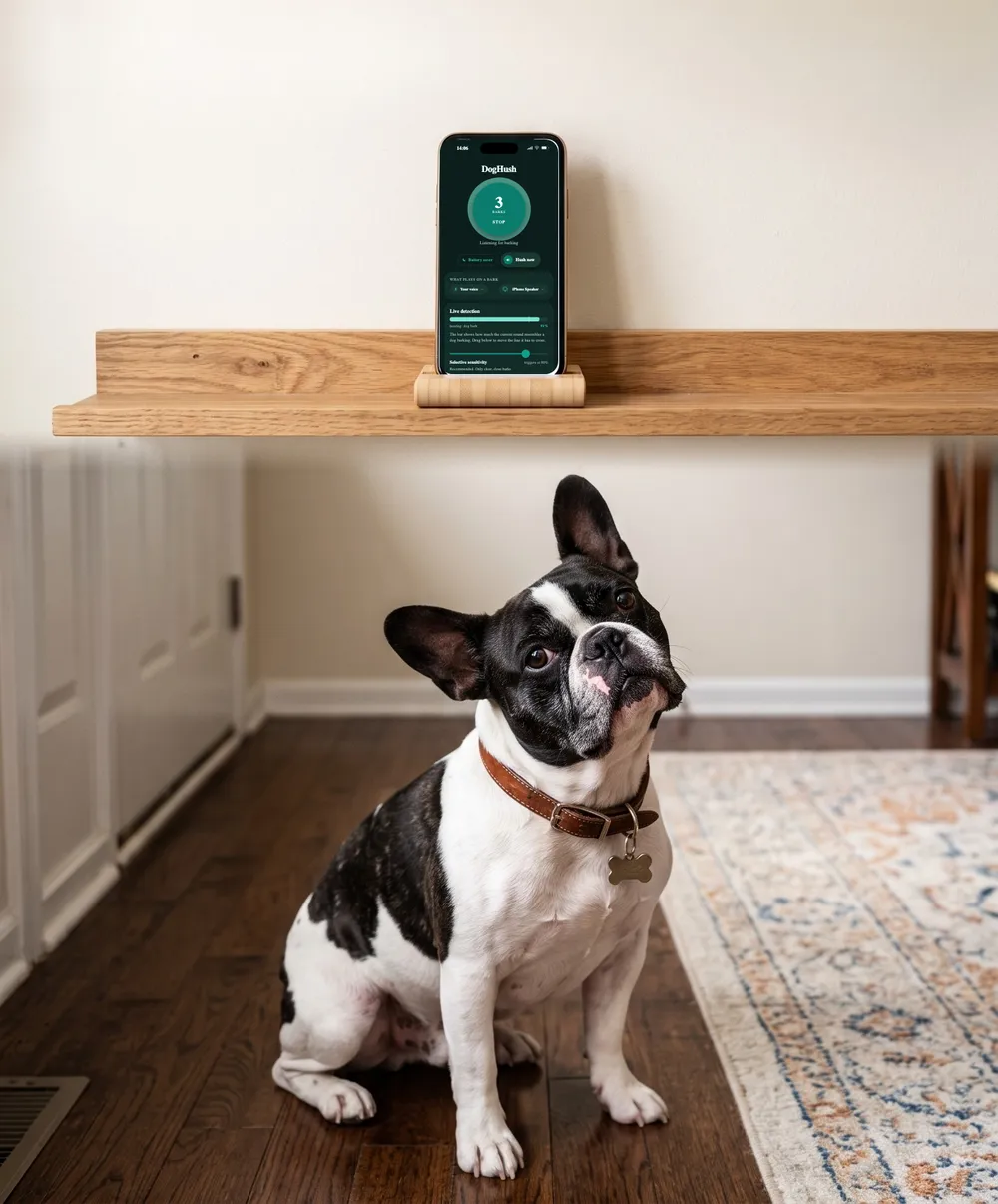
Teaching the word? DogHush repeats it for you, in your own voice, every time he barks.
★★★★★ “It worked way better than I thought.” App Store review
3 days free · Cancel anytime
Why does my dog hate the mail carrier?
He probably doesn’t hate anyone. Dogs are protective of their territory, and the AKC describes how the delivery itself builds the habit: the carrier comes to the door, drops something off and leaves after the dog barks, which can teach him that barking makes intruders go away. It repeats at nearly the same time six days a week, and with packages, several drivers a day. Few behaviors get practiced so often or rewarded so reliably.
It’s worth taking seriously even if he’s all bark. The U.S. Postal Service says its employees suffered more than 5,200 dog attacks in 2025, and that mail service can be temporarily suspended when a carrier feels unsafe because of a roaming dog.
How do I use the delivery schedule?
Predictability is the one thing on your side. Dogs Trust suggests noting when the mail usually arrives and tracking packages so you can prepare. USPS’s free Informed Delivery service previews incoming mail and packages, which the Postal Service says can help dog owners anticipate when the carrier will come, and most delivery services send an out-for-delivery notice. Keep a week’s note of when he barks and you’ll usually find one or two half-hour windows. Put your management in place before each one, and hold short training sessions just before it, when he is most likely to meet the real thing.
What should I do during the delivery window?
- Block the view of the path and porch with frosted film, blinds or a gate, as Dogs Trust and the ASPCA both recommend. Options and costs.
- Mask the sound. A radio or white-noise machine near the front door covers the engine, footsteps and voices; Dogs Trust suggests a radio for exactly this. What to play.
- Move him. A back room with a long-lasting chew or a stuffed food toy, the kind of puzzle the AKC suggests to redirect his focus. USPS asks owners to put the dog in a closed room before opening the door to a carrier.
- Stop the knock. A note asking drivers not to knock or ring, delivery instructions in your accounts, or a pickup locker. If the bell is the trigger, follow the doorbell plan.
- Don’t take mail from the carrier in front of him. USPS warns that dogs can read the handover as a threat, and asks parents to teach children the same.
How do I train him to stay calm when the truck comes?
- Record the triggers: the truck pulling up, the mailbox lid, footsteps, a van door. Play them quietly enough that he only looks up, then treat, and raise the volume over several days. VCA calls this desensitization and counterconditioning: the trigger, at a level he can handle, paired with food.
- Make the real truck pay. When you’re home and hear it before he reacts, start feeding small treats one after another, and stop when the carrier has gone. Truck means food; truck gone means the food stops.
- Teach a spot. The ASPCA’s method: say “Go to your spot”, throw a treat onto a mat, and build up how long he stays. The AKC suggests a sit-and-watch, or teaching him to grab a toy and go to another room, with a friend playing the carrier.
- Add the quiet cue for the barks that slip through. Here’s how.
- Don’t yell at the window. The AKC notes that any attention can reinforce the barking. Reward the quiet instead.
What about deliveries while I’m at work?
Most of them happen then, so the management has to run without you: view blocked, sound on, and him away from the front of the house. If he already knows a quiet cue, DogHush can help with the barks that still get through. Leave an iPhone at home, plugged in, with the app open on screen, and it answers each bark within about a second with your recorded word, through the phone or a Bluetooth speaker. Its history shows whether the barking clusters at delivery time, and whether it’s shrinking.
Be clear about what it can’t do. It answers after the barking starts, and the carrier still leaves, so it doesn’t remove the reward the way a covered window does. Treat it as a backup to management, not a replacement. It also can’t help a dog who is distressed at being alone; that needs a different plan.
When is it more than barking?
If he lunges at the door, scratches to get out, or barks while backing away with his tail low, that is fear or serious guarding, not just an alarm. Keep him well away from the door at delivery times, never let him out while the carrier is there, and see your vet or a trainer who uses reward-based methods. Punishment makes fear worse; the ASPCA advises never to use it when barking comes from fear or anxiety, and the American Veterinary Society of Animal Behavior recommends reward-based training only.
Sources
- American Kennel Club. Why Does My Dog Bark at the Mail Carrier? https://www.akc.org/expert-advice/training/why-does-my-dog-bark-at-the-mail-carrier/
- U.S. Postal Service (2026). Postal Service Names Top Cities and States for Dog Attacks on Mail Carriers. https://about.usps.com/newsroom/local-releases/dc/2026/0528-postal-service-names-top-cities-and-states-for-dog-attacks-on-mail-carriers.htm
- Dogs Trust. How to stop your dog barking. https://www.dogstrust.org.uk/dog-advice/training/unwanted-behaviours/stop-your-dog-barking
- ASPCA. Common Dog Behavior Issues: Barking. https://www.aspca.org/pet-care/dog-care/common-dog-behavior-issues/barking
- VCA Animal Hospitals. Introduction to Desensitization and Counterconditioning. https://vcahospitals.com/know-your-pet/introduction-to-desensitization-and-counterconditioning
- American Veterinary Society of Animal Behavior. Humane Dog Training Position Statement, 2021. https://avsab.org/wp-content/uploads/2021/08/AVSAB-Humane-Dog-Training-Position-Statement-2021.pdf
This guide is general information about dog behaviour, not veterinary advice. A sudden change in barking, or barking with signs of distress, is a reason to see a vet.