 DogHush
Let your dog bark two or three times, say one word once in a calm voice, and hold a treat right at his nose. He can’t bark and sniff at the same time, so he goes quiet, and the moment he does, he gets the treat. Then you make him wait a little longer for it each time. Most dogs have the idea within about three days of five-minute sessions.
Which word should I use?
Any short word works, in any language, as long as it is always the same one. English-speaking trainers usually say “Quiet”; some prefer “Enough” or “Hush”. The dog learns the sound, not the meaning. Two words are worth avoiding: “No”, because he hears it all day with nothing attached to it, and anything you tend to shout.
Day one: one word, one treat
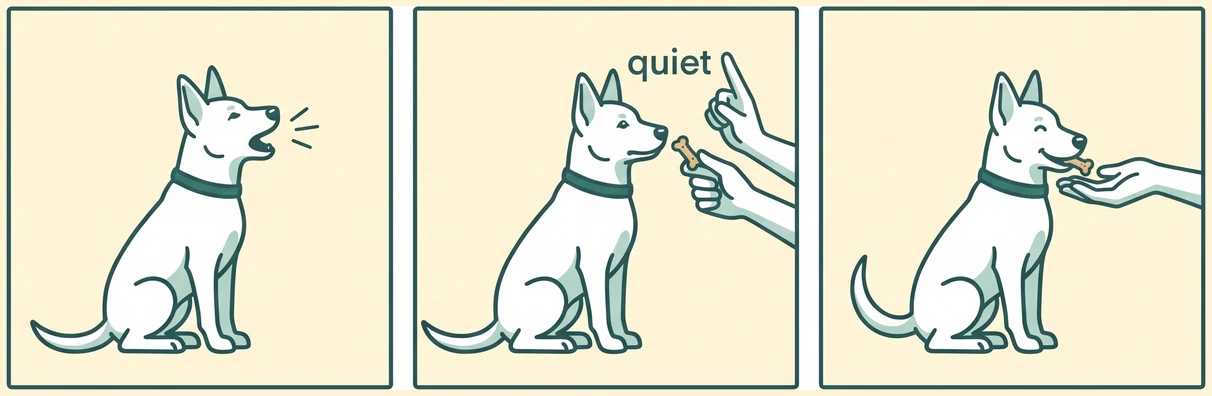
- Wait for real barking: the doorbell, a knock, someone passing the window.
- Let him bark two or three times. In the first pause, say your word once, calm and firm.
- Put a small, good treat right in front of his nose.
- The instant the barking stops, give it to him. A few more while he stays quiet.
Keep it to ten or twenty tries and five to ten minutes. That is the session length the San Francisco SPCA recommends for each step of this exercise.
Day two and three: make the quiet longer
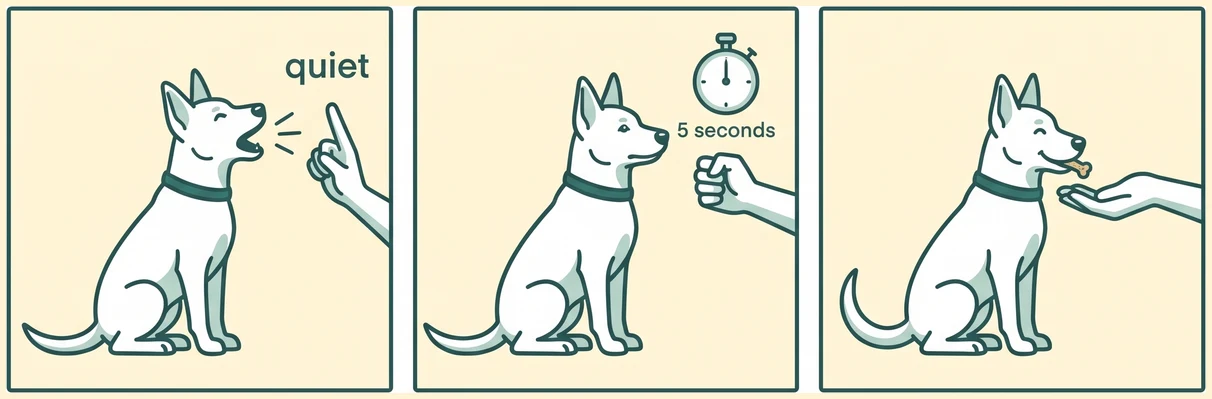
Now the treat stops being a lure and becomes a reward. Say the word, then wait one second of silence before the treat. Next try, two seconds. Then five, ten, thirty. If he starts barking again before you pay, you went too fast: go back one step and build it up again.
Practise where the barking really happens, not only in the kitchen. A dog who is quiet on cue by the sofa may have no idea the word applies at the front door.
What makes it fail?
- Shouting. To a dog, a person yelling at the door sounds like joining in. The ASPCA notes that it can raise his excitement instead of lowering it.
- Repeating the word. “Quiet, quiet, QUIET” teaches him the first two don’t count.
- Paying late. The treat has to arrive while he is silent, not after he has started again.
- Punishing. The American Veterinary Society of Animal Behavior recommends reward-based methods only; aversives carry welfare risks and work no better.
Then what keeps it working?
Consistency. The word has to be said every time, and that is the part a person can’t do from the office. It is what DogHush is for: once he knows the word, you record it, and the app says it back within about a second of every bark, even when you’re out. Keep rewarding the quiet when you are home, and the word keeps its meaning.
Sources
- San Francisco SPCA. Quiet Command. https://www.sfspca.org/resource/quiet-command/
- ASPCA. Common Dog Behavior Issues: Barking. https://www.aspca.org/pet-care/dog-care/common-dog-behavior-issues/barking
- Best Friends Animal Society. How to Teach a Dog to Speak and Be Quiet. https://bestfriends.org/pet-care-resources/how-teach-dog-speak-and-be-quiet
- American Veterinary Society of Animal Behavior. Humane Dog Training Position Statement, 2021. https://avsab.org/wp-content/uploads/2021/08/AVSAB-Humane-Dog-Training-Position-Statement-2021.pdf
This guide is general information about dog behaviour, not veterinary advice. A sudden change in barking, or barking with signs of distress, is a reason to see a vet.