 DogHush
Usually not. Yelling can pause barking for a moment, but to many dogs a raised voice sounds like you’re joining in, it adds to the excitement, and for a dog barking for attention it’s a reward. The American Veterinary Society of Animal Behavior lists shouting among the intimidation techniques trainers should avoid. What works better is one calm word said once, a reward the moment he goes quiet, and fewer things to bark at.
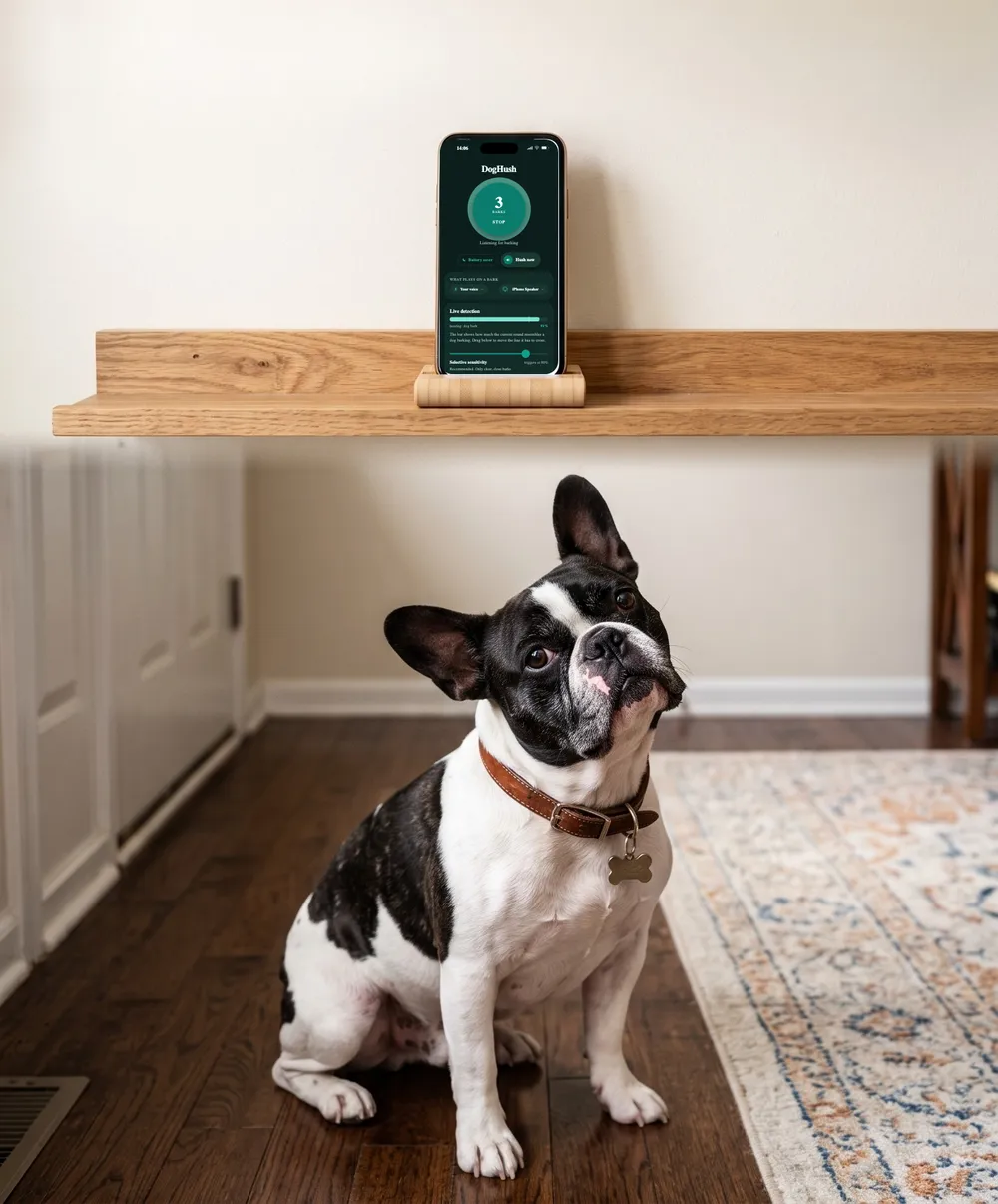
Teaching the word? DogHush repeats it for you, in your own voice, every time he barks.
★★★★★ “It worked way better than I thought.” App Store review
3 days free · Cancel anytime
Why does it seem to work sometimes?
Because a sudden loud noise startles almost anyone into a pause. A startle isn’t a lesson, though. Nothing in that moment tells him what you want instead, so when the delivery truck comes back, so does the barking. It works on you, too: you yell, the noise stops for a second, and that brief relief is enough to make yelling a habit.
Why can yelling make barking worse?
- It sounds like joining in. Dogs Trust warns that some dogs may think you’re joining in. The AKC puts it more bluntly: to your dog it only sounds like you’re barking too, and barking is contagious.
- It raises the temperature. A dog barking at the door is already keyed up. VCA notes that yelling may just add to the noise, anxiety and conflict, and encourage him to bark even more. The ASPCA’s advice for the quiet cue is to avoid shouting and use a calm, clear voice.
- It pays attention barking. If he barks at you to get something, a telling-off is still attention. The ASPCA notes that dogs can count scolding, talking and even eye contact as a reward, and the AKC agrees that negative attention is still attention.
- It can cost you his trust. Dogs Trust adds that some dogs become afraid of you instead. The RSPCA’s rule is never to shout at or punish your dog, and AVSAB links intimidation-based methods to fear, avoidance, and dogs that are less likely to interact with their people.
Yelling and a calm cue, side by side
| Yelling | One calm, trained word | |
|---|---|---|
| What he hears | More noise, often a lot like barking | A familiar signal that quiet is about to pay |
| His excitement | Usually goes up | Comes down, once he knows the word |
| Attention barking | Gets rewarded | Only silence gets rewarded |
| Over time | The word itself can become something he dreads | The word keeps its meaning as long as quiet keeps paying |
What should I do instead?
- Pick one word and say it once, calmly. “Quiet”, “Enough” or “Hush” all work; what matters is that it’s always the same word in the same voice. If he’s heard “Quiet” shouted for years, start fresh with a new word. AVSAB notes that dogs taught a cue with aversive methods kept showing stress when they later heard it, as if the cue itself had become unpleasant.
- Pay for the quiet. Hold a treat at his nose, and the moment he stops, give it to him. VCA’s rule is that the reward comes as soon as the barking stops. Then ask for a second of silence, then two, then five. Dogs Trust suggests a jackpot of extra rewards when he’s unexpectedly quiet. The full method is in how to teach a quiet command.
- Remove the triggers you can. The ASPCA and the RSPCA both recommend blocking his view of people and animals going past. Dogs Trust suggests planning around the predictable ones, such as trash day, and the RSPCA suggests keeping treats or toys ready to redirect him, ideally before he starts. For the front door, see the doorbell plan.
- Ignore barking that’s aimed at you. Turn away, wait for silence, then give him what he wanted. Hold out: Dogs Trust warns that giving in after a long stretch teaches a dog to keep going, because eventually it works.
I’ve been yelling for years. Is it too late?
No. Dogs learn from what happens now, not from what happened last year. Stop yelling completely rather than mostly, since an occasional outburst keeps the old pattern alive, and give the new word a few weeks of short, daily practice. Expect a few bad days. If you live with other people, agree on the word together, because a cue that one person whispers and another shouts is two different cues.
When is it not a training problem?
When the barking is new, nearly constant, or happens mainly when he’s alone. The RSPCA advises ruling out health problems such as hearing loss when a dog suddenly barks more than usual, and notes that barking when left alone can be a sign of distress. Separation anxiety needs a gradual plan with many short absences, and sometimes medication, worked out with your vet or a veterinary behaviorist, as the ASPCA describes. A calmer voice won’t fix that, and neither will a better word. More on barking when left alone.
How do I keep the word consistent?
This is where most people slip. A cue works because it sounds the same every time, and nobody sounds the same at 7 a.m. with a coffee in one hand as at 10 p.m. after a long day, or at all when they’re at work. DogHush is one way to cover that: you record your calm word once, and the iPhone you leave at home, with the app open on screen, plays it back within about a second whenever it hears barking, in the same voice every time. It doesn’t teach the word, so you still reward quiet when you’re home, and it isn’t for a dog who panics when left alone.
Sources
- American Veterinary Society of Animal Behavior. Humane Dog Training Position Statement, 2021. https://avsab.org/wp-content/uploads/2021/08/AVSAB-Humane-Dog-Training-Position-Statement-2021.pdf
- ASPCA. Common Dog Behavior Issues: Barking. https://www.aspca.org/pet-care/dog-care/common-dog-behavior-issues/barking
- VCA Animal Hospitals. Barking in Dogs. https://vcahospitals.com/know-your-pet/barking-in-dogs
- American Kennel Club. Expert Tips to Help Curb Excessive Dog Barking. https://www.akc.org/expert-advice/training/curb-excessive-dog-barking/
- Dogs Trust. How to stop your dog barking. https://www.dogstrust.org.uk/dog-advice/training/unwanted-behaviours/stop-your-dog-barking
- RSPCA. Understanding Your Dog’s Behaviour. https://www.rspca.org.uk/adviceandwelfare/pets/dogs/behaviour
- RSPCA. How to Stop Your Dog Barking Too Much. https://www.rspca.org.uk/adviceandwelfare/pets/dogs/behaviour/barking
- ASPCA. Common Dog Behavior Issues: Separation Anxiety. https://www.aspca.org/pet-care/dog-care/common-dog-behavior-issues/separation-anxiety
This guide is general information about dog behaviour, not veterinary advice. A sudden change in barking, or barking with signs of distress, is a reason to see a vet.