 DogHush
Most night barking comes from one of six things: sounds or animals outside that a quiet house makes easier to notice, a need to go out, energy left over from a dull day, a sleeping spot that is lonely or noisy, anxiety, or, in an older dog, pain or age-related cognitive decline. Note when it happens, what he does, and whether it is new. Sudden night barking in a senior dog calls for a vet visit first.
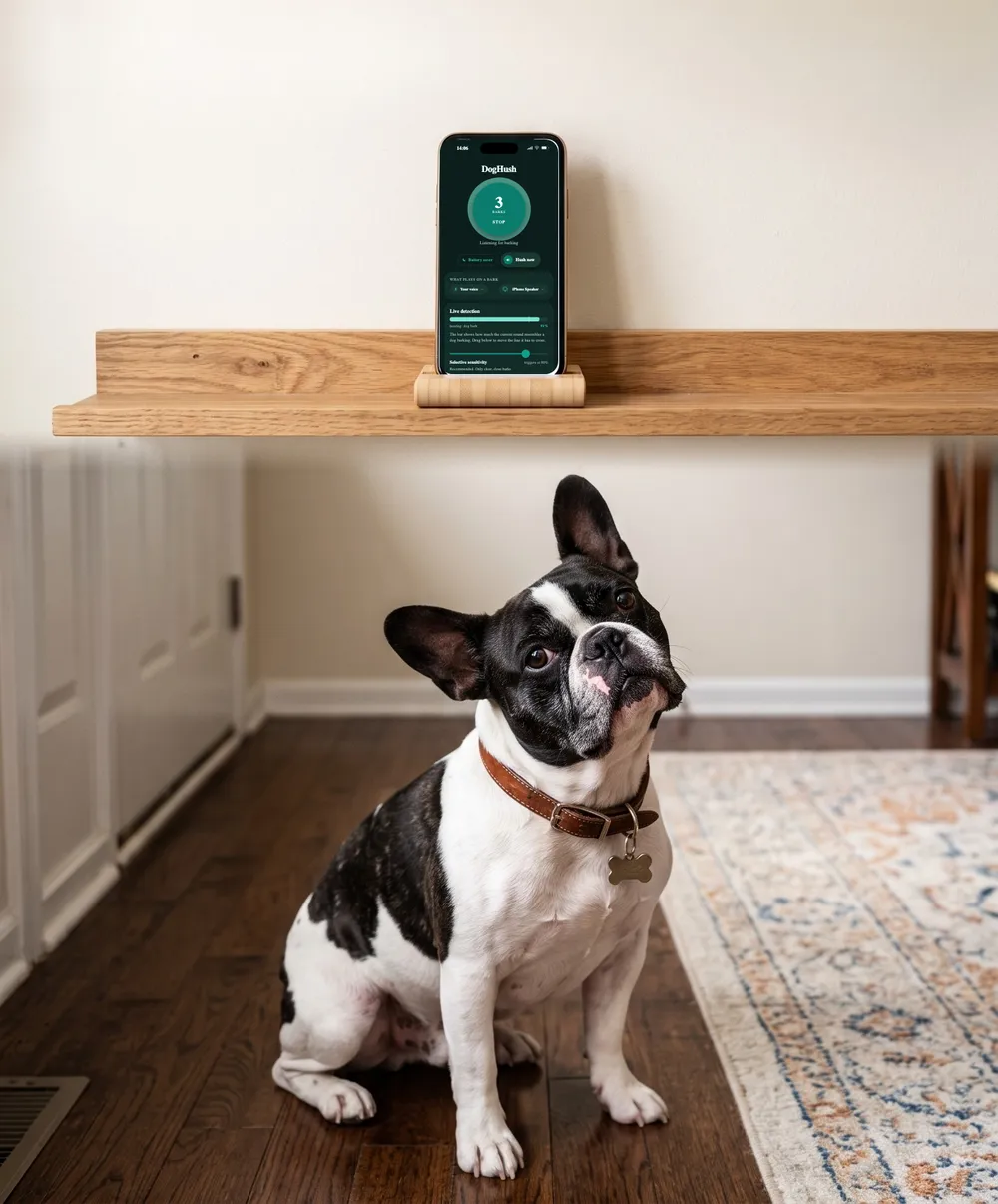
Teaching the word? DogHush repeats it for you, in your own voice, every time he barks.
★★★★★ “It worked way better than I thought.” App Store review
3 days free · Cancel anytime
Why does he bark at night and not during the day?
Dogs Trust notes that with fewer distractions at night, outside noises, or pain, are harder to ignore. And the AKC notes that dogs see with about a quarter of the light people need and hear soft high-pitched sounds you can’t, so a fox or a car door at 1 a.m. is real to him even when you hear nothing.
How do I tell which cause it is?
Record a few nights; note the time, where he faces, and what he does next.
| Cause | What it usually looks like | Start with |
|---|---|---|
| Noises and wildlife | Short bursts at a window or door, often the same hours each night | Mask the sound, close the curtains |
| Needing to go out | Barks or whines at the door, settles after a toilet trip | A last toilet trip right before bed |
| Spare energy or attention | Barks at you, brings toys, worse on lazy days | More exercise and an evening chew |
| Where he sleeps | Barks when shut away, quiet when he can see or hear you | Move his bed closer to you |
| Anxiety | Panting, pacing, trembling; often distressed when left by day too | Your vet or a veterinary behaviorist |
| Age-related change | An older dog, new night waking, pacing or confusion | Your vet, first |
Many dogs have more than one; rule out medical and toilet causes first.
What do I do about noises outside?
- Mask them. Dogs Trust suggests a radio or white noise, and having him sleep in the quietest part of the house. What to play.
- Close the curtains where he sleeps, as you’d cover a window by day.
- Bring him in. VCA advises keeping dogs who bark alone outdoors inside unless someone is out with them.
- Acknowledge it calmly. The AKC suggests a quiet “thank you” so he knows the warning was heard.
He needs to go out. How do I keep it from becoming a habit?
Make a last toilet trip part of a regular bedtime; Dogs Trust notes that barking may be the only way a dog who needs to go can wake you. If he wakes you, go out on a leash, say little, don’t play, and go straight back to bed, so getting up means toilet, not a party. Puppies are different: many can’t hold their bladder through the night yet, and the PDSA’s vets advise against ignoring one who cries at night. In an adult dog, a sudden new need to go out at night is worth a vet visit.
What if it’s boredom, attention or loneliness?
A dog who has had a proper walk, a training game and a bedtime chew has far less to say at 2 a.m. Dogs Trust notes that some dogs learn barking brings the family to entertain them, and VCA’s rule is never to reward barking with attention, even occasionally. Once you’re sure he doesn’t need the toilet, wait for a pause and reward the quiet. If he sleeps shut away, move him closer: Dogs Trust notes that dogs who sleep away from their family may feel lonely, and a bed in or near your bedroom often helps.
My older dog has started barking at night. Is it dementia?
It can be. Canine cognitive dysfunction is an age-related decline in brain function, and a reversed sleep-wake cycle is a typical sign. VCA describes dogs who sleep more by day and become restless, often pacing, at night; the AKC says barking or pacing in the middle of the night can be a sign of confusion; and the PDSA notes that affected pets can become more vocal, usually at night.
But arthritis pain, kidney disease and failing sight or hearing can look much the same, so start with your vet. There is no cure, but treatment can help, and the PDSA notes that earlier is better. Keep his routine predictable, and never punish a confused dog; he isn’t misbehaving.
What shouldn’t I do?
- Don’t shout. The AKC warns that to him it sounds like you’re barking too.
- Don’t punish. The American Veterinary Society of Animal Behavior recommends reward-based methods only, and the ASPCA warns never to punish barking from fear or anxiety. That includes a bark collar left on overnight.
- Don’t forget the neighbors. New York City’s code, for example, treats 5 continuous minutes of plainly audible animal noise between 10 p.m. and 7 a.m. as unreasonable, against 10 minutes by day.
Can an app answer him so I don’t have to get up?
For alert barking, within limits. DogHush runs on an iPhone on your nightstand or near his bed, plugged in, with the app open on screen; it keeps the screen awake and dims it. When he barks, it answers within about a second with your recorded cue, or a whistle tone or short sound, through the iPhone or a Bluetooth speaker by his bed. Its 12-hour chart then shows when the barking happened, which helps you tell a 3 a.m. toilet call from a fox at midnight.
It works best with a dog who already knows the word. It can’t let him out, ease pain or settle a confused dog, and it isn’t for anxiety. For those, get up, or call your vet.
Sources
- Dogs Trust. How to stop your dog barking. https://www.dogstrust.org.uk/dog-advice/training/unwanted-behaviours/stop-your-dog-barking
- American Kennel Club. Why Does My Dog Bark at Nothing? https://www.akc.org/expert-advice/training/why-does-my-dog-bark-at-nothing/
- VCA Animal Hospitals. Barking in Dogs. https://vcahospitals.com/know-your-pet/barking-in-dogs
- PDSA. Vet Q&A: Why do puppies cry at night? https://www.pdsa.org.uk/what-we-do/blog/vet-qa-why-do-puppies-cry-at-night
- VCA Animal Hospitals. Behavior Counseling: Senior Pet Cognitive Dysfunction. https://vcahospitals.com/know-your-pet/behavior-counseling-senior-pet-cognitive-dysfunction
- American Kennel Club. Recognizing Behavioral Changes in Senior Dogs. https://www.akc.org/expert-advice/health/recognizing-behavioral-changes-in-senior-dogs/
- PDSA. Dementia in pets. https://www.pdsa.org.uk/pet-help-and-advice/looking-after-your-pet/all-pets/dementia-in-pets
- ASPCA. Common Dog Behavior Issues: Barking. https://www.aspca.org/pet-care/dog-care/common-dog-behavior-issues/barking
- American Veterinary Society of Animal Behavior. Humane Dog Training Position Statement, 2021. https://avsab.org/wp-content/uploads/2021/08/AVSAB-Humane-Dog-Training-Position-Statement-2021.pdf
- New York City Administrative Code §24-235, Animals (noise). https://nycadmincode.readthedocs.io/t24/c02/sch06/
This guide is general information about dog behaviour, not veterinary advice. A sudden change in barking, or barking with signs of distress, is a reason to see a vet.