 DogHush
Yes. DogHush, an iPhone app, detects barking on the phone itself and answers each bark within about a second with an adjustable high-pitched whistle tone, with your own recorded voice, or with the tone followed by your voice, with nobody tapping anything. It keeps doing that while you are out, as long as the iPhone stays at home with the app open. A tone only keeps working if your dog has learned what it means, so the app includes a short reward-based guide to teaching a quiet cue, and it is not the right tool for a dog that panics when left alone.
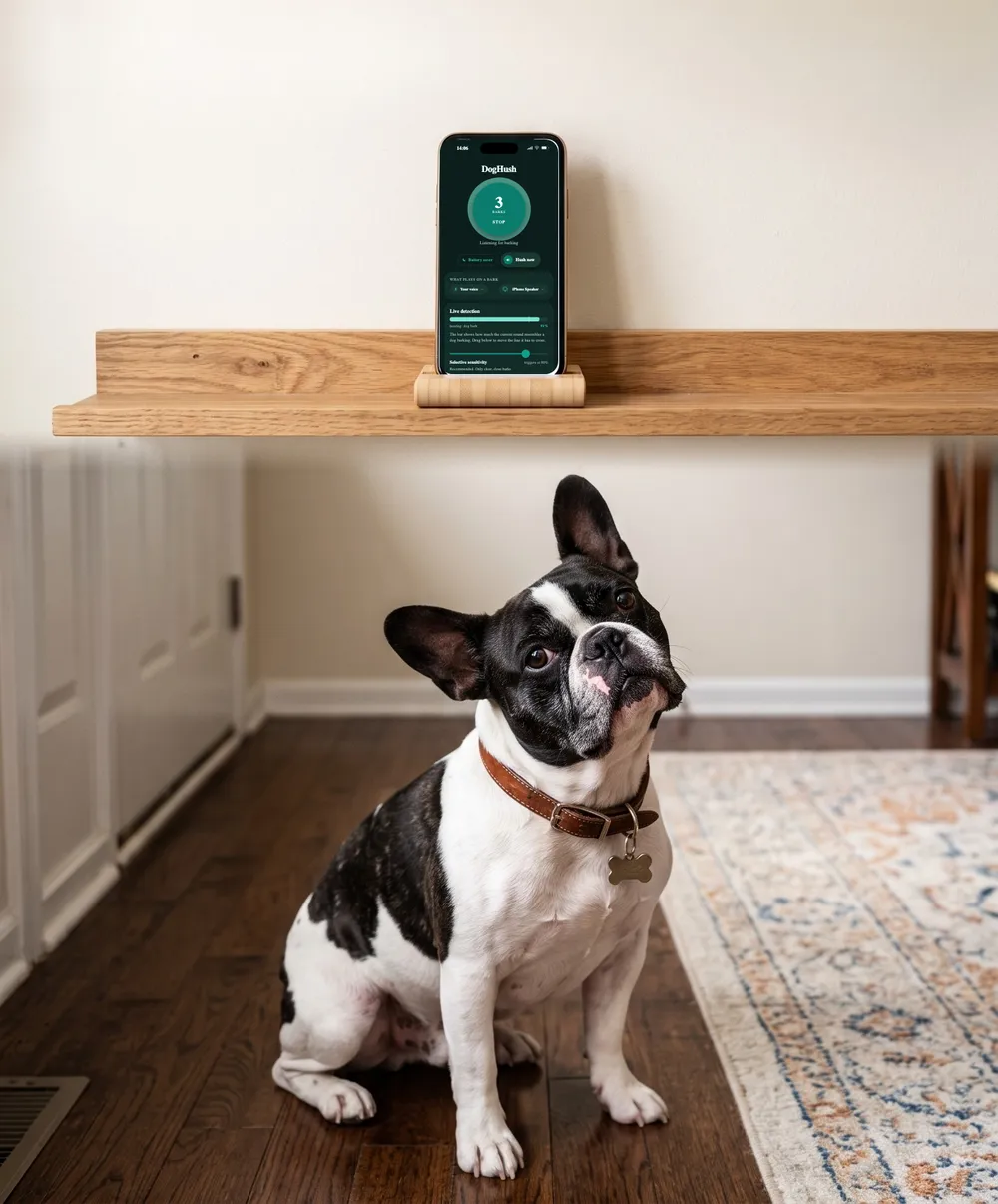
DogHush hears barking by itself and answers in your own voice. No collar, no shock.
★★★★★ “It worked way better than I thought.” App Store review
3 days free · Cancel anytime
 On a computer? Point your iPhone camera here. or email yourself the link.
Why do ordinary whistle apps need me there?
Open any "dog whistle" app on the App Store and you get a slider and a big button. It plays a tone for as long as you hold it. That is fine for getting a dog's attention on a walk. It does nothing for the barking that matters most: the barking at the doorbell, at the hallway, at the window, and the barking that happens while you are at work. By the time you have found the phone and pressed the button, the bark is over, and the dog has learned nothing about which sound the tone was answering.
What changes behavior is consistency: the same answer, every time, within a second or two of the bark. That is a job for the phone, not for you.
What does DogHush play when it hears a bark?
You choose, in the app:
- A whistle tone. High-pitched and adjustable, so you can find the pitch your dog notices and a level that gets attention without startling.
- Your own voice. You record one word once, in any language, and the app plays it at every bark.
- The tone, then your voice. The tone gets his attention; the word tells him what to do.
- A short sound, if your dog responds to that better.
Whatever you choose plays through the iPhone speaker, a Bluetooth speaker or AirPlay, and the app keeps a history (barks today, a 12-hour chart, daily and weekly totals) so you can see whether the barking is going down.
Is the tone ultrasonic?
No, and that is a good thing. A phone cannot produce true ultrasound; apps that claim to are playing a high pitch you may or may not hear. DogHush's tone is audible and adjustable, which means you can hear that it is playing, set a volume that is comfortable in the room, and check your dog's reaction yourself. A sound you cannot hear is a sound you cannot judge.
Does a tone actually stop barking?
By itself, for a few days at most. The controlled trials of high-pitched deterrents are unimpressive: in one, no device repelled every dog at any setting, and in another, guide dogs simply noticed the units and carried on. A sound that predicts nothing is ignored within days; dogs habituate to it like they habituate to traffic.
A tone that predicts something is different. If the whistle has come to mean "stop, and something good follows", it is a cue like any other word, and some dogs respond to a tone better than to a voice. That is the reason the app pairs its tone with a three-day, five-minutes-a-day guide to teaching a quiet cue with treats, and why veterinary behavior organizations recommend reward-based methods over startling the dog.
| Tap-to-play whistle app | DogHush tone | DogHush voice | |
|---|---|---|---|
| Who triggers it | You, by hand | The bark itself | The bark itself |
| Works while you're out | No | Yes, iPhone at home with the app open | Yes, iPhone at home with the app open |
| Same answer every bark | Only if you're fast | Yes, within about a second | Yes, within about a second |
| Keeps working after a week | Rarely | If taught as a cue | If the dog knows the word |
| Best for | Attention on a walk | Dogs that respond better to a tone than to a word | Dogs that know a quiet word |
How do I set it up?
- Open DogHush and choose the response: tone, voice, or tone then voice. Record your word if you use the voice.
- With your dog in the room, play the tone once and adjust the pitch and volume until he looks up without flinching. Comfortable, not startling.
- Spend three days teaching the cue with treats, five minutes a day, so the sound means something.
- Leave the iPhone in the room where he barks, plugged in, with the app open on screen. The app keeps the screen awake and dims it.
- Check the 12-hour chart when you get home. Fewer barks, closer together, is the pattern you want to see shrink.
When is it the wrong tool?
When the barking is panic at being alone: howling or barking from minutes after you leave, with pacing, drooling or damage around doors. No sound fixes that, and a tone can make it worse; that needs a vet or a veterinary behaviorist. It also does nothing for a deaf dog, or for a neighbor's dog that has never learned the cue. For the alert barker who knows a word, or will learn one, DogHush is on the App Store with a three-day free trial.
Sources
- Blackshaw, J. K. et al. (1990). Aversive responses of dogs to ultrasonic, sonic and flashing light units. Applied Animal Behaviour Science 25. https://www.sciencedirect.com/science/article/abs/pii/016815919090064K
- Moxon, R., Allison, A., England, G. (2010). Effect of ultrasonic devices on the distraction behaviour of guide dogs. International Journal of Orientation & Mobility 3(1). https://reference-global.com/article/10.21307/ijom-2010-003
- American Veterinary Society of Animal Behavior. Humane Dog Training Position Statement, 2021. https://avsab.org/wp-content/uploads/2021/08/AVSAB-Humane-Dog-Training-Position-Statement-2021.pdf
- ASPCA. Common Dog Behavior Issues: Barking. https://www.aspca.org/pet-care/dog-care/common-dog-behavior-issues/barking
- San Francisco SPCA. Quiet Command. https://www.sfspca.org/resource/quiet-command/
This guide is general information about dog behaviour, not veterinary advice. A sudden change in barking, or barking with signs of distress, is a reason to see a vet.