 DogHush
Yes. DogHush, an iPhone app, hears your dog bark and answers within about a second with a word you recorded in your own voice, even while you’re out, as long as the iPhone stays at home with the app open. It suits a dog who barks at noises or when left alone without being anxious, and who knows a quiet word or will learn one. A pet camera, by contrast, lets you talk live only after an alert, and a smart-speaker routine plays music or a stock sound, not your voice. DogHush isn’t for separation anxiety: if he panics when you leave, see a vet.
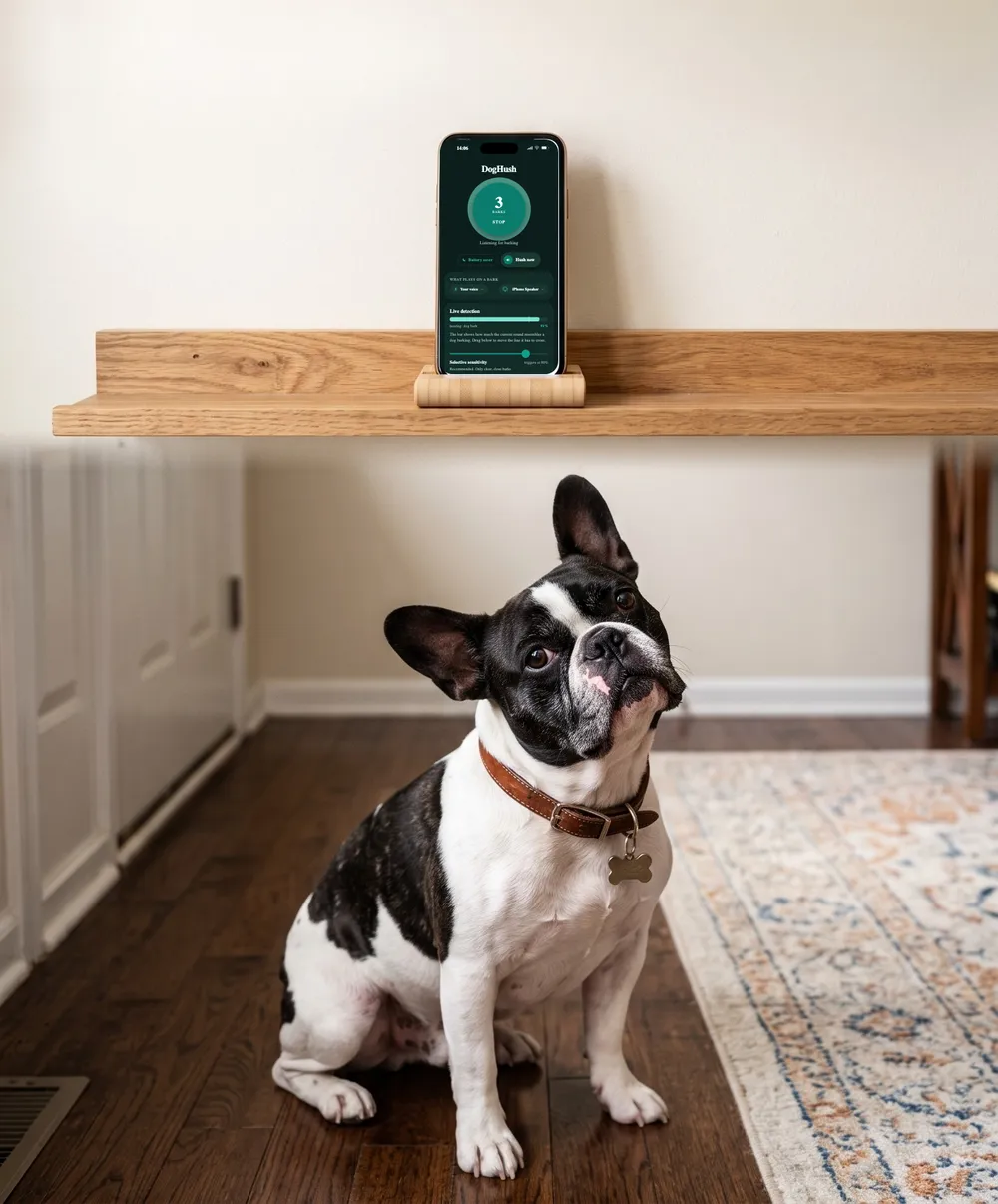
DogHush hears barking by itself and answers in your own voice. No collar, no shock.
★★★★★ “It worked way better than I thought.” App Store review
3 days free · Cancel anytime
How does that compare with a pet camera or a smart speaker?
Here is how DogHush compares with the kinds of tool owners usually try first.
| Option | Plays your voice by itself? | What you need | Worth knowing |
|---|---|---|---|
| DogHush (iPhone app) | Yes, within about a second of barking | An iPhone with iOS 16.4 or later left at home with the app open; a subscription after a 3-day free trial | Can also play a whistle tone, a short sound, or the tone followed by your voice |
| A pet camera with two-way audio | No. You get a bark alert and talk live | A camera, and you free to answer | Camera speakers are small, and you have to see the alert in time |
| A smart-speaker routine | No. It can react to barking with music or a stock sound | A smart speaker that can detect sounds | Not your voice |
| Dog whistle apps | No. You press a button | Any phone | A tone, not a word. Do they work? |
Other options are listed as kinds, not brands. DogHush prices are US prices; the App Store shows yours in local currency.
Does a recording of my voice actually help?
For the right dog, there is reason to think so. Dogs picked out their owner’s recorded voice in 82% of trials in a 2022 experiment, so the recognition is real. In a 2021 study, a bark-triggered program played an owner-recorded clip whenever 40 dogs with separation-related problems vocalized, and their vocalizing time fell by 95.7% over two weeks. It wasn’t a study of our app and had no control group, so treat it as a promising lead, not proof.
Two other findings set the limits. Timing matters: when researchers played a voice continuously during separation, dogs mostly just looked at the speaker. And quality matters: trained dogs responded to about 70% of recorded cues through a loudspeaker, against nearly all of them in person. A clear recording through a decent speaker, right after the bark, is the version with a chance. More in do dogs recognize a recorded voice.
How does DogHush do it?
You record a short command once: any word, in any language. Leave the iPhone at home, plugged in, with DogHush open on screen; the app keeps the screen awake and dims it. When it hears barking, it plays your command within about a second, through the iPhone speaker, a Bluetooth speaker or AirPlay. You can swap the voice for an adjustable whistle tone or a short sound, or play the tone followed by the voice. Its history shows detections today, a 12-hour chart, and daily and weekly totals, so you can see whether the barking is going down. There is no account, and no audio leaves the phone.
It needs no camera or other hardware, only an iPhone you can leave behind, and answering the bark is its main job. It costs a 3-day free trial, then $4.99 a week or $29.99 a year in the US. The app itself is in English, though your command can be in any language.
Who is it for?
- Alert barkers. Dogs who bark at the doorbell, the hallway or the window while you’re out.
- Dogs who know a word, or owners willing to teach one first. The app includes a guide to teaching a quiet command in about three days, five minutes a day, with treats.
- Owners with a spare iPhone that can stay at home, on and plugged in.
Who shouldn’t use it?
- Dogs with separation anxiety. Barking or howling that starts within minutes of your leaving, with pacing, drooling or damage around doors, needs a vet or a veterinary behaviorist. A recorded voice doesn’t treat that, and a distressed dog may search for you and get worse. How to tell the difference.
- Deaf or hard-of-hearing dogs. A sound can’t reach them.
- A neighbor’s dog. Your voice means nothing to him.
- Android users, and anyone who can’t leave an iPhone at home with the app open. iOS doesn’t allow this kind of listening in the background.
If you’d rather speak live, a pet camera with two-way audio lets you do that when you’re free to answer; whether talking through one helps depends on the dog.
What should I do first?
Teach the word. A recording repeats a cue; it doesn’t give the cue its meaning, whichever tool plays it. Start with how to teach a quiet command, keep rewarding quiet when you’re home, and only then let an app say it for you. If DogHush fits your dog, it’s on the App Store.
Sources
- Gábor, A. et al. (2022). The acoustic bases of human voice identity processing in dogs. Animal Cognition. https://link.springer.com/article/10.1007/s10071-022-01601-z
- Tiira, K. (2021). Digital Dogsitter reduces vocalization in dogs suffering from separation-related problems. Applied Animal Behaviour Science 243. https://doi.org/10.1016/j.applanim.2021.105460
- Kinnaird, R. F., Wells, D. L. (2022). The effect of auditory stimulation on pet dogs’ reactions to owner separation. Applied Animal Behaviour Science 254. https://pure.qub.ac.uk/en/publications/the-effect-of-auditory-stimulation-on-pet-dogs-reactions-to-owner/
- Sound quality impacts dogs’ ability to recognize and respond to playback words (2025). Scientific Reports. https://www.nature.com/articles/s41598-025-96824-8
- ASPCA. Common Dog Behavior Issues: Separation Anxiety. https://www.aspca.org/pet-care/dog-care/common-dog-behavior-issues/separation-anxiety
This guide is general information about dog behaviour, not veterinary advice. A sudden change in barking, or barking with signs of distress, is a reason to see a vet.